Irish Whiskey Industry Tariffs: Rising Costs, Trade Pressure, and What It Means for the Future
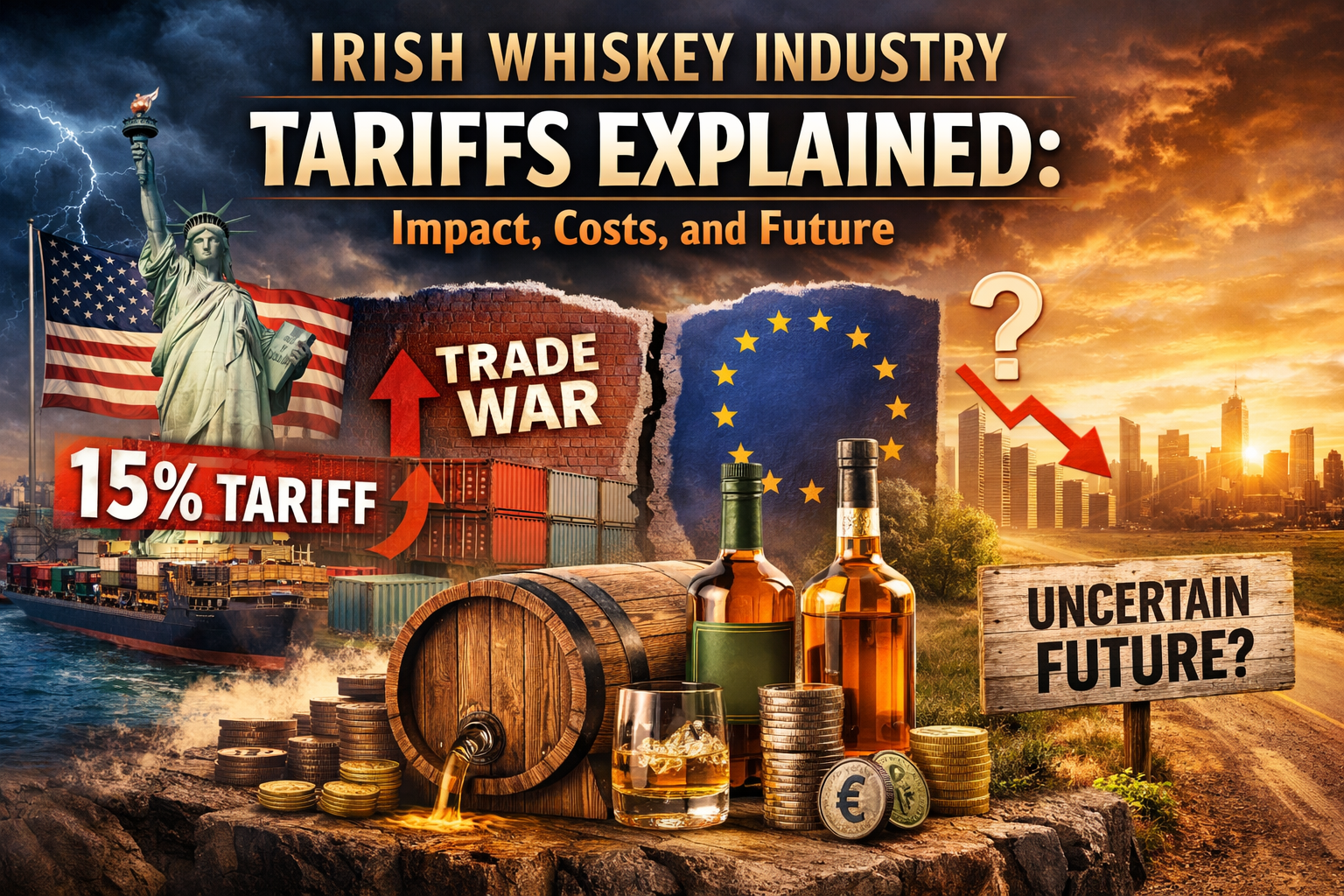
The Irish whiskey industry tariffs have become one of the most serious challenges facing the global whiskey market in 2025 and 2026. What was once a fast growing and highly profitable export industry is now dealing with rising costs, trade uncertainty, and shifting global dynamics.
At the center of this issue is a 15% United States tariff on European Union goods, including Irish whiskey. Some earlier reports suggested a 10% rate, but the effective pressure on Irish producers has increased over time. These tariffs are directly affecting pricing, exports, and long term growth.
In simple terms, Irish whiskey is still popular around the world, but tariffs are making it harder and more expensive to sell, especially in its most important market.
What Are Irish Whiskey Industry Tariffs and Why They Matter
The Irish whiskey industry tariffs refer to import taxes placed by the United States on Irish whiskey produced in the European Union. These tariffs are part of broader trade tensions between the US and EU, and they are not limited to whiskey alone.
However, whiskey has become one of the most visible industries affected by these policies.
The reason this matters so much is simple. The United States is the largest market for Irish whiskey, and a huge share of exports depend on it. When tariffs increase costs in such a major market, the entire industry feels the impact.
Even small percentage increases can change pricing strategies, reduce demand, and force producers to rethink their global approach.
The Current Tariff Situation in 2025 to 2026
As of mid 2025, Irish whiskey produced in the Republic of Ireland faces tariffs of up to 15% when entering the US market. Earlier discussions and trade adjustments showed a lower 10% rate, but the effective burden has increased.
At the same time, whiskey produced in Northern Ireland, which is part of the United Kingdom, faces a lower tariff of around 10%.
This difference creates an unusual situation where two products from the same island face different trade conditions in the same market.
This imbalance is now one of the most talked about issues in the whiskey industry.
Why the US Market Is So Important
The United States is not just another export destination. It is the backbone of the Irish whiskey industry.
Around 95% of Irish whiskey production is exported globally, and a large share of that goes to the US. The market is valued at approximately €420 million annually, making it the most valuable destination for Irish producers.
Because of this strong dependence, any change in US trade policy immediately affects the entire industry.
If costs rise in the US, producers cannot easily replace that market overnight. This makes tariffs especially damaging compared to other trade barriers.
How Tariffs Are Increasing Prices
Tariffs directly increase the cost of importing Irish whiskey into the United States. This cost does not stay with importers alone. It moves through the supply chain and eventually reaches the consumer.
Importers pay more to bring whiskey into the country. Distributors then adjust their pricing. Retailers and bars increase shelf prices to maintain margins.
As a result, consumers in the US pay more for Irish whiskey.
This price increase affects buying behavior. Customers may switch to cheaper alternatives or reduce their spending. Over time, this can reduce overall sales volume.
Pressure on Profit Margins
One of the biggest effects of Irish whiskey tariffs is the pressure on profit margins.
Producers cannot always pass the full cost increase to consumers. If prices rise too much, demand may drop. This forces companies to absorb part of the cost themselves.
This situation reduces profitability, especially for brands that compete in the mid range market.
Premium brands may handle this better because their customers are less sensitive to price. However, even they are not completely protected from long term pressure.
A Growing Competition Disadvantage
The difference in tariff rates between the Republic of Ireland and Northern Ireland has created a serious competitive imbalance.
Whiskey produced in Northern Ireland benefits from lower tariffs when entering the US. This gives those brands a pricing advantage compared to products from the Republic of Ireland.
In practical terms, this creates a kind of invisible trade border within the island of Ireland.
Producers in the Republic now face higher costs for the same market, making it harder to compete on price and distribution.
This situation is not only unfair from a business perspective, but it also complicates long term planning for companies operating across both regions.
Impact on Small and Medium Producers
Small and medium sized distilleries are among the most affected by Irish whiskey tariffs.
These businesses usually operate with tighter budgets and lower margins. They do not have the same financial flexibility as large global brands.
When tariffs increase costs, smaller producers struggle to absorb the impact. This can limit their ability to expand, invest, or even maintain their current operations.
Some companies have tried to manage this by shipping products earlier to avoid higher tariffs. This strategy, known as front loading, increases warehousing costs and adds additional financial pressure.
For many small producers, this creates a difficult balance between growth and survival.
Supply Chain and Production Challenges
Tariffs are also affecting the supply chain and production cycles within the Irish whiskey industry.
To avoid higher tariffs, some producers increased shipments ahead of expected policy changes. While this helps in the short term, it creates storage and cash flow challenges.
At the same time, uncertainty around trade policies has led to more cautious decision making.
In 2024, some distilleries even paused or slowed production due to rising costs and unclear future demand. This is a significant shift for an industry that had been expanding rapidly.
These production pauses show how deeply tariffs can influence long term planning and investment.
Export Decline and Market Uncertainty
The Irish whiskey industry has already started to feel the impact of tariffs through changes in export trends.
In 2025, exports to the United States experienced a slight decline. While demand for Irish whiskey remains strong, higher prices and market pressure have affected sales performance.
This decline is not dramatic, but it signals a change in momentum.
For an industry that was previously growing year after year, even a small slowdown raises concerns about the future.
Industry Response and Lobbying Efforts
The Irish whiskey industry is not ignoring these challenges. Key organizations are actively working to address the issue.
Groups such as the Irish Whiskey Association and Drinks Ireland are pushing for a return to tariff free trade. They argue that removing tariffs would benefit both producers and consumers.
Their goal is to restore a stable and predictable trade environment where Irish whiskey can grow without unnecessary barriers.
At the same time, companies are exploring alternative markets to reduce dependence on the US.
Shifting Toward New Global Markets
To reduce risk, Irish whiskey producers are expanding into other regions.
Markets in Asia, South America, and other parts of Europe are becoming more important. These areas offer new growth opportunities and help balance losses from tariff affected markets.
However, building a presence in new markets takes time and investment. It is not an immediate solution to the challenges created by US tariffs.
Still, this shift shows that the industry is adapting and looking for long term stability.
The Bigger Picture: Trade Volatility
The Irish whiskey tariff situation is part of a larger global trend of trade uncertainty.
Economic tensions between major regions like the US, EU, and UK continue to influence policies and tariffs.
For industries like whiskey, which depend heavily on exports, this volatility creates ongoing challenges.
Businesses must now plan for multiple scenarios and remain flexible in their strategies.
Future Outlook for Irish Whiskey Industry Tariffs
The future of Irish whiskey tariffs depends on political decisions and trade negotiations.
If tariffs remain at current levels, the industry will likely continue to face cost pressures and slower growth.
If tariffs increase further, the impact could become more severe, especially for smaller producers.
However, if tariffs are reduced or removed, the industry could return to strong growth, particularly in the US market.
Despite current challenges, the long term outlook for Irish whiskey remains positive due to strong global demand and a growing reputation for quality.
Final Thoughts
The Irish whiskey industry tariffs represent a major turning point for the industry. They have introduced new costs, created competitive imbalances, and forced producers to rethink their strategies.
While these challenges are serious, they are not permanent. The industry has shown resilience in the past and continues to adapt to changing conditions.
In the end, Irish whiskey remains a strong and growing global category. Tariffs may slow progress, but they are unlikely to stop it.
FAQs About Irish Whiskey Industry Tariffs
What are Irish whiskey industry tariffs?
They are taxes placed on Irish whiskey when it is imported into countries like the United States, increasing its cost.
How much is the US tariff on Irish whiskey?
As of 2025, tariffs can reach up to 15% for EU produced Irish whiskey, while Northern Ireland whiskey faces around 10%.
Why is the US market so important?
The United States is the largest and most valuable market, with exports worth around €420 million annually.
Do tariffs increase whiskey prices?
Yes, tariffs raise import costs, which leads to higher prices for consumers.
Who is most affected by these tariffs?
Small and medium sized distilleries are most affected because they have limited resources to absorb extra costs.
Are exports declining بسبب tariffs?
Yes, exports to the US showed a slight decline in 2025 due to higher costs and market pressure.
What are companies doing to adapt?
They are exploring new markets, adjusting supply chains, and lobbying for tariff free trade.
Can tariffs be removed in the future?
Yes, tariffs depend on trade agreements and may change through negotiations.
More Articles:
Pigeimmo Explained: Meaning, Uses, and Real Estate Value
Wasatha: Meaning, Principles, and the Power of a Balanced Life
